

Mastering English Spelling: Comming or Coming?
“Comming or coming” is a common question for English learners. The word coming is the correct spelling and it means something is on its way or about to happen. The spelling comming is always wrong. It is simply a spelling mistake in English.
Many people still get confused between comming vs coming. It looks similar, so the error feels small. But the mistake changes how professional your writing looks. A tiny error can make a big difference. This is why spelling matters in every situation.
The confusion happens because of English spelling rules. Words sometimes double consonants, but not in “come.” That is why the present participle of come is written as “coming.” Knowing this rule helps you avoid the spelling mistake comming in writing.
Understanding the Difference: “Comming” vs. “Coming”
At first sight, coming vs comming look very similar, but only one of them is correct. The word coming is the present participle of come, and it is the right spelling. You use it when talking about something that is happening now or in the near future. For example, you might say, “He is coming to the office tomorrow,” or “The rain is coming soon.”
On the other hand, comming incorrect spelling is simply a mistake. It does not exist in standard English and will be marked wrong in any dictionary or grammar guide. The reason many people write it this way is because of misunderstanding of English spelling rules such as the consonant doubling rule and the silent e rule examples, both of which we will explain in detail.
Why “Comming” Is Incorrect
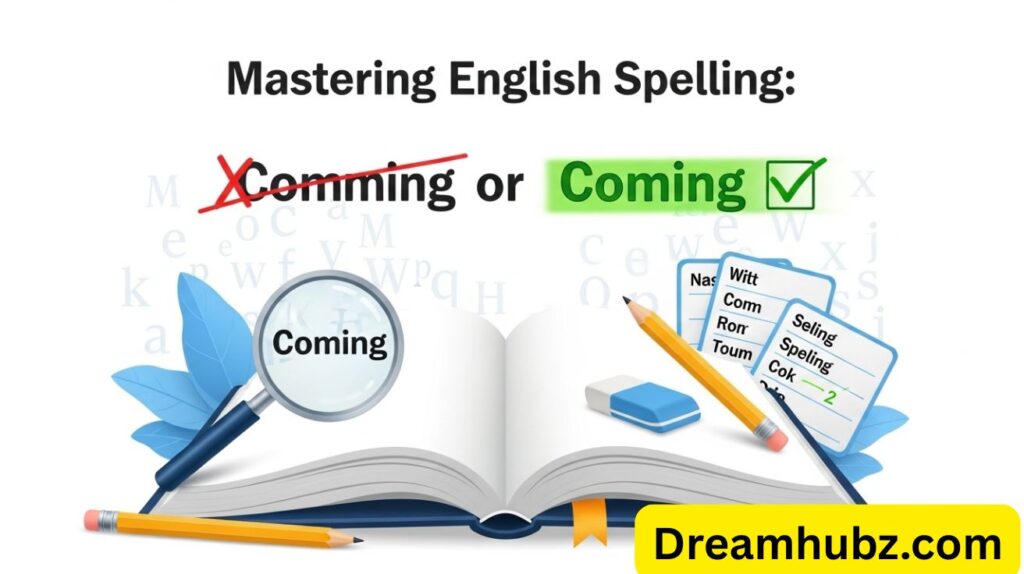
The main reason comming incorrect spelling is wrong is because it does not follow the rules of English word formation. The base word is come, and when you add “-ing” to it, the correct form is coming. There is no need to double the letter “m,” since the word does not meet the requirements for doubling consonants.
Consonant Doubling Rule
One of the most confusing parts of English spelling rules is knowing when to double a consonant before adding “-ing.” The consonant doubling rule says that you only double the last consonant if three conditions are met: the word ends in a single consonant, the vowel before it is short, and the stress is on the final syllable.
Examples of Correct Doubling:
| Base Word | With “-ing” | Reason for Doubling |
| Run | Running | Ends with single consonant after a short vowel |
| Stop | Stopping | Short vowel, final syllable stressed |
| Begin | Beginning | Stress on last syllable |
Examples Without Doubling:
| Base Word | With “-ing” | Why No Doubling? |
| Meet | Meeting | Long vowel sound, no doubling needed |
| Listen | Listening | Ends in more than one consonant |
| Happen | Happening | Stress is on the first syllable |
The word come does not fit the doubling rule. It ends in a silent “e,” not a consonant, so doubling the “m” would be wrong. That is why the correct form is coming and never “comming.”
The Silent “E” Rule
Another important rule in English is the silent e rule examples. This rule says that if a word ends with a silent “e” and you want to add a suffix that starts with a vowel, such as “-ing” or “-ed,” you must drop the “e” first. This keeps the word flowing naturally and avoids extra letters.
Examples of the Silent “E” Rule:
| Base Word | Correct Form |
| Love | Loving |
| Bake | Baking |
| Move | Moving |
| Come | Coming |
By applying this rule, we can clearly see why the correct spelling is coming and not “comming.”
Scenario Example: The Incorrect Use of “Comming”
Imagine writing an important email to your boss in the United States. You might type:
“Thank you for comming to the meeting this morning.”
While your boss will still understand the message, this spelling mistake comming looks unprofessional. In the workplace, such professional email mistakes can make it seem like you did not check your writing. Small errors like this reduce your business writing clarity and can affect how seriously people take your message.
The Correct Use: “Coming”
Now let us correct that sentence:
“Thank you for coming to the meeting this morning.”
This version looks polished, correct, and professional. Good spelling supports effective communication in writing and shows attention to detail, which is especially important in business and academic settings.
Why Do We Make This Mistake?
There are many reasons why people write comming instead of coming. Sometimes learners overgeneralize spelling rules like consonant doubling. At other times, phonetic confusion in English makes the mistake feel natural, since the word sounds like it has two “m” sounds. Typing quickly can also lead to common typos in writing, where an extra letter is added by accident. Finally, for many learners, not knowing the rules of spelling, such as the silent e rule examples, makes it easy to fall into errors.
Common Spelling Errors and How to Avoid Them
The error of “comming” is only one example in a long list of common spelling mistakes in English. People often struggle with other words as well. The following table shows some of the most frequent errors and the correct forms, along with simple memory tricks to avoid them.
| Common Error | Correct Spelling | How to Remember |
| Definately | Definitely | Think of “finite” inside “definite” |
| Seperate | Separate | “A rat” is in “separate” |
| Recieve | Receive | Follow rule: I before E except after C |
| Occured | Occurred | Double the “r” because stress is on the second syllable |
| Alot | A lot | Always two words |
Learning these rules and practicing them will improve your spelling. For spelling tips for ESL learners, it is also helpful to use proofreading strategies such as reading your text aloud or checking it with tools.
How Writing Tools Can Help
In modern writing, spelling checker tools are a lifesaver. They catch mistakes instantly and suggest the right corrections. For example, typing “comming” will automatically be flagged as wrong by most tools, and they will suggest the correct spelling of coming. Two of the most popular tools are Grammarly and ProWritingAid, and both are useful for avoiding errors.
Grammarly
Grammarly is one of the most widely used writing assistants in the United States. It checks spelling, grammar, and style in real time. It integrates easily with browsers, Microsoft Word, and Google Docs. If you write “comming,” Grammarly will immediately highlight it as a mistake and suggest “coming.” Beyond spelling, it also helps with business writing clarity and prevents grammar and spelling errors in professional emails.
ProWritingAid
ProWritingAid is another advanced tool that not only corrects spelling but also analyzes your style and structure. It is especially popular among writers who want deeper insights into their work. It offers reports on readability, sentence variety, and even tone. When comparing Grammarly vs ProWritingAid, Grammarly is faster for everyday corrections, while ProWritingAid gives more detailed reports for improving your overall effective communication in writing.
Examples of “Coming” in Different Contexts

The best way to master a word is by seeing it in real examples. Below are four ways to use coming correctly in both formal and casual settings.
In a Business Email
“The team is coming together for the quarterly meeting, and we are excited to share our results.”
A Motivational Speech
“You are coming closer to your goals every day. Do not give up, because success is near.”
In Casual Conversation
“Are you coming to the game tonight? It will be so much fun.”
In Literature
“As the storm was coming, the villagers hurried to lock their doors.”
Why Spelling Errors Matter in Professional Settings
In the United States, employers and colleagues often judge professionalism by how well you write. Writing professionalism is not only about grammar but also about spelling. A simple mistake like writing comming incorrect spelling in a report or email can make your work seem rushed. Correct spelling, on the other hand, shows respect for your readers and ensures effective communication in writing.
Read Also : 320 Inappropriate Group Chat Names
The Role of Proper Spelling in Effective Writing
Spelling is one of the most important parts of effective communication in writing. When you use the correct spelling of coming instead of the spelling mistake comming, your sentences are easier to read and understand. Readers do not get distracted by errors, and your ideas remain clear. Accuracy in spelling helps you express thoughts smoothly and professionally.
For students, professionals, or ESL learners, spelling accuracy is linked to writing professionalism. Mistakes such as confusing comming or coming can weaken your credibility. Clear writing builds trust, whether you are writing an academic paper, a business email, or a blog post. Correct spelling ensures that your message reaches the audience exactly as intended without misunderstandings.
Avoiding the “Comming” Trap: Tips for Writers
Writers often fall into the “comming” trap because of phonetic confusion in English and overgeneralizing the consonant doubling rule. To avoid this, it is important to remember that “come” ends with a silent “e.” According to the silent e rule examples, we drop the “e” and add “-ing,” resulting in the correct form “coming.” This simple rule prevents the mistake.
Another effective strategy is practicing proofreading strategies. Reading your work aloud or using spelling checker tools like Grammarly and ProWritingAid helps you catch errors. These tools will always flag “comming incorrect spelling” and suggest “coming.” By learning these patterns and double-checking your work, you can avoid common typos in writing and maintain polished, professional communication in every context.
Why Spelling Errors Matter in Professional Settings
In the workplace, even a small spelling mistake comming can hurt your image. Employers in the United States often connect accurate writing with business writing clarity and attention to detail. If your emails or reports contain errors, it may seem careless or unprofessional. Correct spelling ensures your ideas are respected and your message is taken seriously by colleagues and clients.
Correct spelling also shows respect for the reader. Errors like “comming vs coming” can distract the audience from your message. In professional environments, where accuracy matters, grammar and spelling errors may reduce your credibility. That is why spelling is not just about language rules—it is about building trust, authority, and confidence in your communication skills.
The Importance of Learning Proper Spelling
Learning proper spelling is essential for improving how to improve spelling skills and mastering English. Mistakes such as writing “comming” instead of “coming” are easy to fix once you understand the rules. By studying English spelling rules, practicing the silent e rule examples, and avoiding overgeneralization of the consonant doubling rule, you will write with more confidence and accuracy.
Spelling is also important for lifelong learning. Whether you are an ESL student or a native speaker, learning correct spelling improves both reading and writing. It helps you avoid the misspelled words list that often confuses learners. With consistent practice, careful proofreading, and the help of spelling tips for ESL learners, you can develop error-free, professional writing.
Understanding Why Spelling Builds Confidence in Writing
Correct spelling is not only about following rules; it also builds confidence. When writers know they are using the right form, like “coming” instead of “comming,” they focus more on expressing ideas. This reduces self-doubt and makes writing flow naturally without the constant worry of being judged for small mistakes.
Confidence in writing leads to better communication. Whether you are writing for school, business, or personal use, spelling accuracy shows you care about details. Mistakes such as the spelling mistake comming can create unnecessary stress. On the other hand, mastering spelling rules gives you the freedom to write with clarity and authority in any context.
How Spelling Shapes First Impressions
The way you spell words affects how people see you. Using the wrong form, such as “comming incorrect spelling,” may give the impression that you are careless or inattentive. On the other hand, writing “coming” correctly shows responsibility and professionalism. First impressions in communication are often made through written words before face-to-face meetings.
In the U.S., where business writing clarity is highly valued, correct spelling is essential. Employers, colleagues, and even friends often form opinions based on your writing style. By paying attention to details like comming or coming, you show that you respect your audience. This creates trust and builds stronger relationships in both professional and personal communication.
The Connection Between Spelling and Clear Thinking
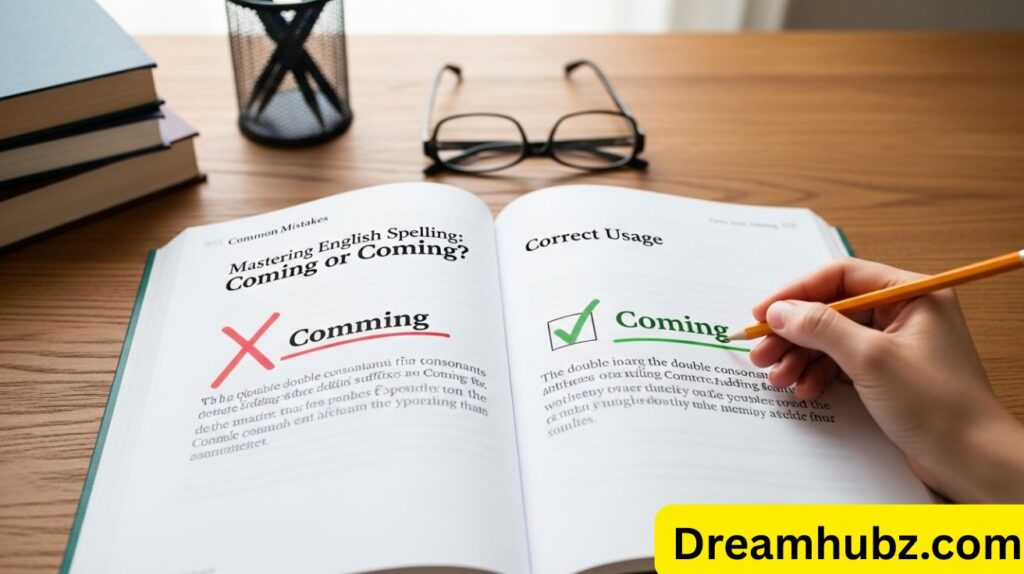
Spelling is more than letters on a page; it reflects clear thinking. When you understand English spelling rules, such as the silent e rule examples, your mind organizes language more effectively. This allows you to write logically and avoid confusion. Correct spelling, like writing “coming,” keeps your thoughts structured and makes your writing easier to follow.
Mistakes such as “comming vs coming” often break the reader’s flow. When words are misspelled, readers pause to interpret meaning, which weakens your message. Accurate spelling ensures that ideas move smoothly from the writer’s mind to the reader’s understanding. This connection between spelling and thought makes good writing powerful, direct, and professional.
Improving Spelling Through Daily Practice
Spelling skills improve with consistent practice. Reading widely, writing regularly, and reviewing common spelling mistakes in English help strengthen memory. Learning the consonant doubling rule and practicing proofreading strategies will train your eyes to spot mistakes like “comming” instantly. Over time, daily practice makes correct spelling a natural habit rather than a conscious effort.
Modern tools also make practice easier. Spelling checker tools like Grammarly and ProWritingAid give instant corrections and explanations. They highlight errors such as “comming incorrect spelling” and suggest “coming.” This real-time feedback helps writers, especially spelling tips for ESL learners, to recognize patterns and avoid repeating mistakes. With steady practice, spelling mastery becomes second nature.
FAQ,s
Is “comming” a real word?
No, comming is not a real word. The correct spelling is coming, which is the proper present participle of “come.”
Is “I’m coming” grammatically correct?
Yes, I’m coming is grammatically correct. It uses the verb “come” in its present participle form to show an action happening now or soon.
Is it coming soon or comming soon?
The correct phrase is coming soon. The spelling “comming soon” is always wrong and should be avoided.
Is it tomorrow or Tommorow?
The correct spelling is tomorrow. Writing “tommorow” is a common error found in the misspelled words list.
Conclusion
The debate between comming or coming is easy to settle once you understand the rules. The present participle of come is always coming, never “comming.” The mistake happens because of confusion with the consonant doubling rule, the silent e rule examples, or simply because of typing errors. By learning the rules, practicing with examples, and using modern spelling checker tools, you can avoid this error and many others in the misspelled words list.
As a final takeaway, remember this simple rule: if a verb ends in a silent “e,” drop the “e” and add “-ing.” That is why we write coming and not “comming.” With proofreading strategies, tools like Grammarly vs ProWritingAid, and steady practice, you can strengthen your spelling and ensure your writing is always clear, professional, and correct.